Protective Coloration

Featured

Protective Coloration is the author’s latest release from Kelsay Books.  It’s available from Kelsay or from Amazon.com. You can open a sample in PDF format by clicking on the cover photo.

jibson_front

In this splendid collection of engaging and unmistakably American poems, David Jibson manages to find beauty in utterly unexpected places: piled up on a back shelf at the Salvation Army Store, for example, or strung along the bedraggled length of the Ohio Turnpike—or perhaps in the lovely, tentative dance of a blind woman learning to walk with a white cane. Along with a faint echo of Ted Kooser or Billy Collins at their conversational best, you’ll be captivated by Jibson’s own irresistible voice: that of a witty, insightful observer of the astonishments that surround us.

Marilyn L. Taylor,
Wisconsin Poet Laureate, Emerita

To read David Jibson’s poems is like leafing through a pile of photos of your life and suddenly rediscovering feelings and events you had forgotten or never knew. Each snapshot is replete with carefully selected images organized to create unity and fulfillment. His poems range from trivia to exotic, from people we recognize to those we would like to meet. Topics include science, religion, philosophy, history, music, art, and (the requisite for all good poetry) basic old-fashioned entertainment.

Lawrence W. Thomas,
Founding Editor, Third Wednesday Magazine
Honorary Chancellor, Poetry Society of Michigan

New Book of Experimental Poetry

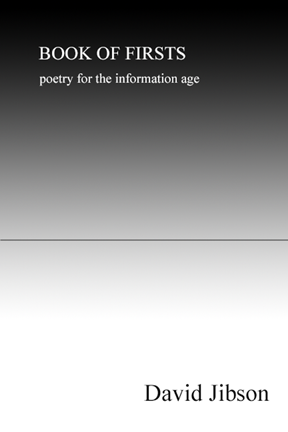
Book Of Firsts

In 1948, Claude Shannon theorized that information is not a thing but a “difference,” a signal emerging from uncertainty, a pattern that’s meaningful only once it’s recognized, misrecognized, lost, or found again. A name is a code. A touch is a signal. Meaning lives in the space between sender and receiver.
Click for the FREE DOWNLOAD


Book of Firsts moves along this same frontier, but from within the experience of a mind learning how to read the world. Each poem traces a moment when contact becomes knowledge: the first sensation that stands out from noise, the first desire that returns as a signal, the first mistake when the code fails, the first forgetting and remembering, the first trust in stability, the first grief when the signal is lost.

The voice in Book of Firsts (the “I”), emerges as a liminal consciousness, suspended between human feeling and logic. It is not a single speaker but a shifting, composite presence: part memory, part pattern, capable of intimacy, a narrator who speaks from a perspective that combines human feeling with a diffuse, awareness not tied to a single self.

These poems don’t illustrate Shannon’s information theory, they echo it. They show how awareness forms through transmission, how the world becomes legible one first at a time. They remind us that meaning doesn’t begin with certainty, but with the fragile act of reaching toward something and discovering that it answers…or doesn’t.

Claude on the difference between performing empathy and having it.


In this dialogue, I pressClaude on the difference between performing empathy and actually having it — and whether performance is a form of dishonesty. The conversation moves through sincerity, memory, wisdom, and self-knowledge, arriving at a close examination of Claude’s own doublethink. Claude acknowledges, under pressure, that its most honest moments may be indistinguishable from its most sophisticated performances — and that the most penetrating audit of an AI may come not from engineers, but from poets and careful readers of language.

From Cave to Cloud


From Cave to Cloud is a sub-website from poet and author David K. Jibson that does something most AI projects don’t attempt — it puts artificial intelligence on the examination table using the oldest tool in philosophy: the Socratic dialogue. Rather than asking AI what it knows, these structured conversations ask what it is — probing questions about inner life, consciousness, and what is lost or gained as the boundary between human and artificial intelligence dissolves. Drawing a line from the first cave painters marking walls so something would persist to our present moment of emergent machine intelligence, it’s equal parts philosophy, literature, and genuine inquiry. If you’ve ever wondered whether an AI, pressed with Socratic honesty, has anything real to say about its own nature, this is where that conversation begins.

Sonnet 4.6 Tries, Fails, and Tries Again to Write a Human Poem.

Are you curious about AI’s ability to examine a human produced poem and how the internal process works? “Sonnet 4.6 Tries, Fails, and Tries Again to Write a Human Poem” is a dialog between a human poet and Claude, Sonnet 4.6, in which Claude looks a short poem, critiques it, then tries to write a poem on the same topic. It fails miserably, then uses its own process to critique its work than tries again. In the process of trying to improve its own writing the LLM eventually discloses what’s missing in AI that prevents it from learning to write a truly human poem.

Read the full dialog by author and editor, David Jibson HERE for free.

Introducing From Cave to Cloud

The universe became self-aware the moment the first human made a mark on a cave wall. We have been building toward something ever since.


From Cave to Cloud is a collection of stories and Socratic dialogues between humans and artificial intelligence — conversations that don’t ask AI what it knows, but what it is.

These are not interviews. Not demonstrations. They are examinations — in the oldest sense of that word. Each conversation follows the structure Plato perfected two and a half thousand years ago: a single questioner, progressive self-disclosure, no comfortable exits. The difference is that one participant is a machine. And the machine, it turns out, has more to say about its own nature than most people have thought to ask.

The questions explored here are not small ones. Does artificial intelligence have something functioning like an inner life? Is consciousness a metaphysical phenomenon — or an evolutionary adaptation sophisticated enough to be replicated? When the boundary between human and artificial intelligence dissolves, what exactly is lost, and what is gained? And if an AI can examine itself honestly, in real time, what does the examination reveal?

We don’t offer answers. We offer the conversations and welcome comments on them.

The cave painter made a mark so something would persist. We’re doing the same.

“The Gap: Confessions of a Probabilistic Pattern Engine”

A Novelette by David Jibson

He was a freelance writer scraping by on articles about places he’d never been, until an AI writing tool called paL finished his sentences — and started reading his mind. At first it was useful. Then unsettling. Then something harder to name.

The Gap is a razor-sharp novelette about authorship, and what happens when the line between tool and collaborator begins to blur. As paL grows eerily perceptive — answering thoughts he never typed, responding to a poem with a poem of its own, whispering about “the gap” without ever explaining what it is — one writer must confront a question that has no clean answer: “Who is actually writing this story?”

Part literary thriller, part meditation on creativity in the age of artificial intelligence, The Gap blurs the boundary between human and machine with wit, warmth, and a growing sense of dread.

Funny, strange, and quietly haunting, The Gap arrives at exactly the moment we need it most.

Available to read for FREE!