The Case for Publishing Your Own Poetry and Giving it Away
Like many people, I came to writing poetry later in life, starting in my late fifties. After a few years of posting to a micro blogging site anonymously, I was ready to seek “legitimacy” through journal publication, so I began submitting and before long, I had some success. A few more years and I felt I had enough published poems that I should start thinking about a book. I put a manuscript together, did some research and chose a publisher that seemed likely to accept it. I was right. A couple of weeks after submitting it my manuscript was accepted by a small press that specializes in publishing poetry by lesser known and new poets.
The quality control my publisher used was a requirement that about a third of the poems in the manuscript had to have a prior publication credit. I exceeded that, choosing only poems with a publication history to include in my book. My goal was to have a published book of poems that an editor somewhere had already selected and published.
I knew going in that small publishers, including mine, didn’t have the resources to do much marketing. I was perfectly accepting of that limitation. I would buy author copies, schedule readings with local book stores and poetry groups where I could, and attend open mic opportunities. I also set up an author web page and social media accounts so I could do my own marketing without spending a lot of money.
My book was published in March of 2020, just as the country and the world went into Covid lock-down so my own marketing plans were blown up. My publisher made the publication announcement to their mailing lists and on their social media platforms. I published sample poems on my author website and social media, but that was the end of it. No readings, no open mics – just a couple of reviews on Amazon and on my local library’s blog.
A couple of years later, I was thinking about another book, so I took a deeper look into my previous experience beginning with some research about various models that publishers use. I discovered some troubling truths about poetry publishing.
One thing I learned is that poets at my level do not make money from having their books published. Only the publisher makes money. That’s how publishing poetry works. In my case, I knew that my publisher would make more than I did whenever a copy of my book sold from their web site or from Amazon – much more.
I learned that small publishers that want to profit have to publish a lot of titles because even their best-selling poets sell a few hundred copies at most and that most poetry books sell fewer than fifty copies. Those who do sell hundreds did so because they, and not the publisher sold them. That’s right, your publisher is not working for you – you are working for your publisher. You buy your author copies at a substantial markup, you sell them from your own website or at readings, book fairs or whatever and no royalties come to you from selling those author copies because your publisher has already made their profit from selling to you.
As poets, the numbers are not in our favor. To begin with, my published book is too expensive. How can I expect to sell a book of poems that costs more than a book by a well-known poet? Paperback books by Billy Collins, Ted Kooser, Naomi Shihab Nye or Ocean Vuong sell for between seven and sixteen dollars, depending on how old they are. The publisher set the price of my book at $18.50. I had no say in that. The author price for the copies I bought (I did get 5 free copies) was ten dollars each, a substantial discount, but that’s the price for me to buy copies of my own work and at that price, the publisher is making more from me than from all other sales.
I did some thinking about what I really wanted out of publishing my poetry and the conclusion I reached is that I wanted to share it with other people who appreciate poetry. I concluded the best way to do that is not through the traditional means open to me. I took a close look into self-publishing. I crunched some numbers. I found that I can get printed copies of a book of between 24 and 100 pages for $2.60 each (about $2.80 with shipping). At that price I can take books to a reading and sell them for three bucks or, better yet, I can give them away for free. But why stop there? Why not use my author website to give away free digital copies? If the sole purpose of publishing is to share my work as widely as possible, what could be better than making it free?
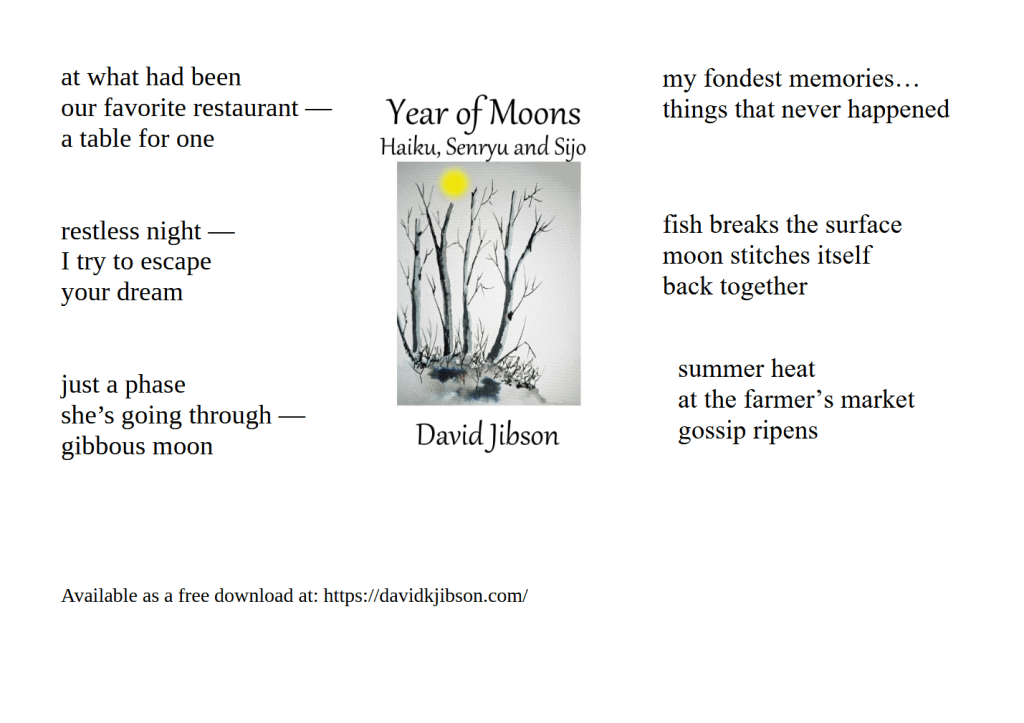
That’s exactly what I did with my next book, a chapbook that I published myself, I ordered thirty copies and sent them to my poetry friends. I was asked to do a presentation on self-publishing at a meeting of a state poetry society. I ordered fifty more copies and gave them away at that meeting. In the first six months the free version was downloaded 107 times from my web site and. on Amazon, ten print copies were sold for a minimal price.
This article was about the “why” of self-publishing. The “how” of self-publishing is something you can research on your own just as I did. I will tell you, there is a learning curve, but not one that’s insurmountable for most people. Learning is no more difficult than a 100-level college course.
Article Update: As of November 2024 free copies of my books have accumulated over 700 downloads. That’s about 200 books per year.
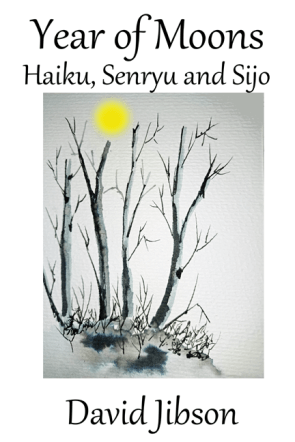 Year of Moons is precious to me. These poems do what I look for; the poem says one thing but means something else. Case in point, my favorite in the collection is a haiku in which the fish breaks the surface. And my 2nd favorite, Way of the River with its ripples of radiating meanings. “Make it [the river] take you where you want to go.” I like the sensual nape of the neck poem, and the way Mr. Jibson makes a poem out of something we’re all familiar with (but don’t write about) like grandmother’s old recipe cards. Of the moon poems, travel moon takes the reader well outside its frame, a great quality in a poem. The same for the Milky Way poem. The thought and research that went into the making of Year of Moons are two of its great qualities, along with the sensitive observations throughout and depth and clarity the writer brought to the project.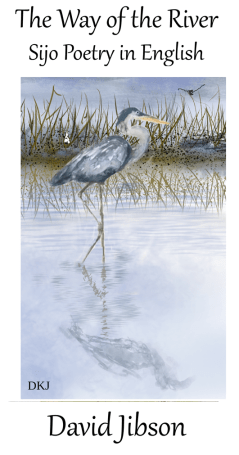



 David K. Jibson